
My experience with NetGalley
Getting reviews for my debut fantasy novel

One of the biggest challenges for a debut indie author is social trust. With literally millions of books being published every year, it is a fair question for a reader to ask—why should I spend money on YOUR book? Is it well written? Is it properly edited and formatted? Does it have the elements of fantasy that I enjoy and avoid the things I don’t? This is where reviews come into play. A well written review is fantastic for social trust, a reader can get those answers before spending a dime. A large number of reviews/ratings also helps. Hundreds of people can’t all be fake or wrong…right?
But reviews can be pretty hard to come by. Estimates vary widely but consensus is generally that less than 10% of readers actually leave reviews and as someone just starting out—who sold let’s say 22 books in the month of release—organic reviews are probably not to be relied upon. I can tell you my mom loved my book—to my own surprise (she closes her eyes during intense movies, guys. I did not expect her to get past my prologue tbh), but who cares? Not a stranger on the internet, that’s for sure.

So, you send out ARCs (free books with the expectation that the receiver posts an honest, public review). There’s a lot of ways to do this, but the one that made the most sense for me—a beginner with no audience to draw volunteers from—was to pay for a secure service to help connect me with advance readers. I chose NetGalley because it is the biggest and simplest platform, and it had the best overall feedback from other indie authors. My goal was 15 reviews because that is what Amazon recommends for a product page. (There’s a million recommended minimum review numbers, with an equal number of justifications. More is more with reviews it seems but 15 seemed accessible to me.)
Here’s how that worked out for me:
I paid for a single month for my title on NetGalley through a co-op with Victory Editing. This cost me 63$. I chose one month because NetGalley shows users books based on genre and upload date; many authors reported that you get so buried after 30 days that it is not worth paying for longer.
Looking at my activity chart, I think this was the right move. I got 418 impressions (unique users who saw my listing) while my book was live. Over 100 of which were from the first 2 days, after that the impressions fell sharply. After the first week, impressions fell to less than 10 per day for the remainder of the month.
Of those 418 impressions, I received 29 requests, and I approved 16. Most of the users I chose to decline was due to a very low review rate, which is the percentage of books that they actually review out of the total books they request. I was warned that some reviewers are unnecessarily harsh and to look out for 1- and 2-star reviews for things like a spelling error or a simple premise. I only encountered one of this type in my requests (or so I thought lol.) I saw many with single digit review rates though, so reviewing at the same rate as regular customers, despite being on a review site. This was the biggest reason I chose to decline certain requests, in my opinion, if these users are not honoring previous agreements, I am not going to give them my book for free.
29 requests is a 6% click through rate. I have no idea if that is good or bad as far as these review sites. That is decent as a click through rate on an ad, so maybe good? I do know that my book cover is not optimized for online scrolling, as the finer details get muddied when in the micro size most browsers will see. Therefore, I am not surprised by this number1. I was expecting more impressions. Some authors who spoke about using NetGalley made it seem like titles would receive thousands of impressions. This could be a category thing. The romantasy category seemed like the hotness on the site to me. There might just be less regular fantasy readers on there at the moment. Or it could be because I chose not to pay for any additional promotions on the site that would have made sure more people saw my listing. I’m not sure.
Either way, 16 people got my book to review. As of this writing, 14 of those people had downloaded the book, but only 3 left reviews. Far short of my goal. However, 2 of those reviews were high quality. Both gave me a good rating but by high quality I mean detailed, thoughtful, and verbose. And both users reached out to me either via email or social media afterwards to connect. The third was both negative and vague, which is extremely frustrating to me. As disappointing as critical reviews can be, I do think that they are still useful if they are detailed. This one was not and pulls down my average rating with harsh and vague words that leave me wondering whether they just want a girl boss or if they lack reading comprehension.2
I am very grateful to those two reviewers who took the time to leave detailed feedback and want to thank them here. Three reviews are better than “my mom loved it” and if you are reading this, thank you! The time you spent to write those has helped me gain a little social trust and I plan to use your feedback to fine-tune my marketing efforts toward readers with similar tastes to yours.
Was it worth it? Cold hard numbers of cost to reviews makes me wince, but call me a softie, because to me, connecting with 2 people who otherwise may never have read my book does seem worth it. And 3 reviews is more than I had before and just confirms my suspicions that people will either love or hate my book lol. Hopefully, the other users who downloaded will eventually submit feedback, and hopefully at least a couple of those 22 sales will too.
Thank you for reading! The Chosen One’s Substitute is no longer available to read on NetGalley, but if you want to read the reviews yourself, you can do so here. I have posted the first 3 chapters to my Substack. They will be pinned to the top of my page if you want a sample to decide for yourself. Or you can just jump in and purchase, if you're feeling bold.
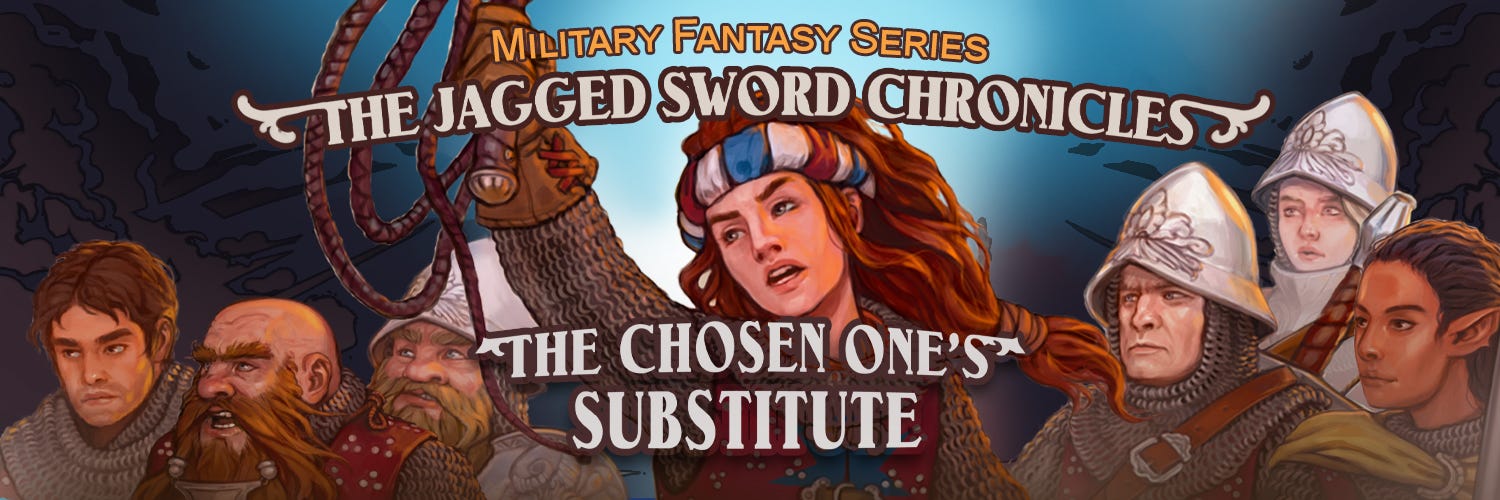
No, that doesn’t make my cover bad. Despite what the publish fast or minimal viable product people will tell you, current data shows that most consumers get books from recommendations now, whether from someone they know, an influencer they trust, or interacting with the author’s social media content. Having a cover that is eye catching in person or on a social media thumbnail and that conveys the correct signals to a potential reader about what is inside is much more important to me than ‘optimizing’.
Yes, I am making assumptions about this user, but I think I have good reason to. They said that they read about 4 chapters and couldn’t connect with the characters and didn’t think my plot was anything new. Ok, fine, fair enough as opinions go. But then they said that they didn’t like how I described women. Assuming the prologue is counted in the four chapters, within my first 4 chapters we have: 1) women being evaluated by a pimp for potential as prostitutes (admittedly gross but also very clearly a trafficking situation in the context of the scene, if the user had reported stopping here the remarks would make more sense but they said they continued for 3 more chapters), 2) a young woman training with magic and having a heart-to-heart with a mentor figure, 3) that same young woman having a tender moment with her much younger sisters including teasing and hair braiding, 4) that young woman having a gigantic farewell with her extended family—most of which are also women, 5) an administrative meeting with high ranking officers—two of which are women, 6) and travel scenes with the young woman and a mix gendered group which includes a monster encounter. You’re telling me that you dislike how all of those different women in all of those different scenarios are described? I call BS. This user posted another review the same day as mine that was rated 5 stars while complimenting the “signature sassy FMCs” which is internet speak for girlbosses. I wrote a large variety of women, but to this user’s disappointment, I did not write any girlbosses, sorry.