
Writer's block isn't real.

“Hold on, didn’t you post about writer’s block in the last few weeks?” I did, a couple of times actually. However, while addressing my struggle to write, I found that calling it writer’s block isn’t helpful, but here are a few things that were.

Writer’s block is colloquially what we call it when someone struggles or is completely unable to write. I say it isn’t real, not because writers don’t find themselves struggling to write. I think it is obviously a common problem. But because there is not a nebulous, uncontrollable thing blocking us from writing. As with many creative problems, it’s actually several problems in a trench coat. I can’t tell you which assortment are yours, but hopefully, what I found while treating my own, is helpful to you.
Easily identifiable reasons we struggle to write:
Exhaustion/stress. It is no coincidence that many authors report having writer’s block immediately before or after a launch or other deadline. My case of the blocks perfectly aligned with the most recent bout of illness that ran through my family. After dealing with a sick toddler and a sick self all day, then trying to write for an hour or two, then getting up multiple times in the night with the sick toddler—rinse and repeat—I was unable to focus on my creative outputs. Taking a week off of writing entirely and simply going to bed early, greatly helped. So, if you are struggling to write, ask yourself if you just need a break.
Stillness/distraction. A creative mind needs to be a bored mind. Creativity simply cannot flourish if you are constantly taking in other’s content. Especially in the “age of distraction”, it is not only possible but easy to slip from one piece of content to another. Tell me if this sounds familiar: You wake up, and check your messages, some of which are memes or reels from friends and family. Then you are scrolling shortform videos and checking emails while getting coffee and breakfast. Then you open a Substack or YouTube notification and algorithm #2 gets you scrolling some more. Then it’s an audiobook or podcast while driving or chores. Then more scrolling on breaks. Maybe a book or a TV show during and after dinner. Finally, you open your writing software, and you can’t write. Now you’re just staring at the blank page with a mind that is equally blank.
Even if we aren’t brainstorming our WIPs, (which I highly recommend doing long before you sit down to write) our brain needs space to shift from processing to creating. I found that turning off the audiobooks or podcasts during showers and chores, gave my brain that space. Sometimes I was trying out different scenarios with my story, other times I was playing around with completely unrelated vignettes that will probably never be written, or occasionally, a pseudo-fan fic in my mind of whatever book I have most recently read. All of these made my words come easier when I finally got the kiddo to sleep and had my writing time. If you feel blocked, check your screen time and count listening time too. Don’t fear boredom. It’s actually good for you.
Salmon/sunshine. Are you fueling your brain properly? Brains run on carbs, but they are made of fats. Especially, if you are feeling generalized brain fog, take a look at your diet and make sure that it is balanced. Whole grains, protein, veggies and healthy fats. I live in Alaska so I will ask myself if I need to lay off the chips and pull a salmon out of the freezer. Wild-caught has the best ratios of Omega fatty-acids (yay brain!) but I understand that can be cost prohibitive in other regions.
Are you getting exercise and spending time outside? Millennia of human development is not undone because we industrialized in the last few hundred years. A brainstorming walk (headphones prohibited) is the single best thing I do for my writing. Unfortunately, I live in Alaska, and we have nasty weather about half the year. I am working on going outside anyway, just making sure I am properly dressed.
For married adults only. When was the last time you got laid? If my husband and I have gone too long without the horizontal tango, I cannot focus for the life of me. I won’t be going into more detail, but I assume you’re an adult reading this. If you are a single adult, you may have to try to dance solo, just be careful about the methods you use. Porn is bad for your brain and your hormones. If by some chance you are under 18 reading this, take a cold shower. I will not recommend a child use this method.
Bad processes. Writing methods are somehow deeply personal and deeply tribal. It is set up by the internet and craft resources that one is either an outliner or a pantser. One gets upheld as correct and regimented and the other romantized. This leads to many young authors using the wrong one. I would argue that this is a false dichotomy, it’s more of a spectrum. On one side there is authors like Stephen King who never writes anything prior to starting to type and on the other is (idk i’m blanking a famous example) with tens of thousands of words in a scene-by-scene outline in a 3-act structure, character profiles, character development arcs and plot arcs.
Most authors are somewhere between these but closer to one side or the other. But the real secret is that both sides are doing some form of brainstorming and plotting, what lands you on your side is HOW you go about it and keep track.
I’m a millennial with a special snowflake complex so I consider myself an intuitive writer. I’m on the pantser side of the spectrum but I do have an outline in the stair step method. How this works for me is I know where my story is starting and how it will end. I have a list of bullet points for major plot points. Then I connect the dots as I write the story. Where I started shooting myself in the foot was, I accidentally stopped brainstorming in the time before I sat down to write the scene. (It’s a long story but as a SAHM a nap change can have some interesting consequences lol.)
Taking time to think through and play out a few different options for how this chapter and the next will go BEFORE I sit down to write is non-negotiable for my writing. Like if you’re climbing a dark stairwell, you know where you are and where you’re going but the flashlight is in the steps directly below your feet. Thus, the methods name.
So, ask yourself if you are using the correct method for you? Or are you using the method that sounds best due to whatever internet advice tickles whatever idea of self you hold tight in your subconscious? Are you plotting enough? Are you outlining too much and losing interest? Are you scheduling brainstorming time into your day just as often (or more) as you schedule writing time?
Less easily identifiable reasons:
Ok, Suzie, I addressed all of those things. I’m eating well, exercising outside and in the bedroom regularly. I have quiet time built into my schedule and limit my screen time. I am not tired or am only my normal amount of tired. But I’m still blocked, now what?
Well, you’re probably just scared. Anxiety, especially anxiety wearing a perfectionist trenchcoat, is a bitch. This is where all the generic writing advice about “it doesn’t have to be good, it just has to be on the page” or “my word goal each day is one word” is coming from. And honestly, they aren’t wrong, just too non-specific.
You cannot edit a blank page, so if you’re afraid to write badly: do it anyway. If you can’t hit your word count goals: lower them. You don’t have to write every day, but you do have to stick to a routine. (Unless you’re struggling with issue #1. Take a break and then restart a routine or change your routine to include more breaks.)
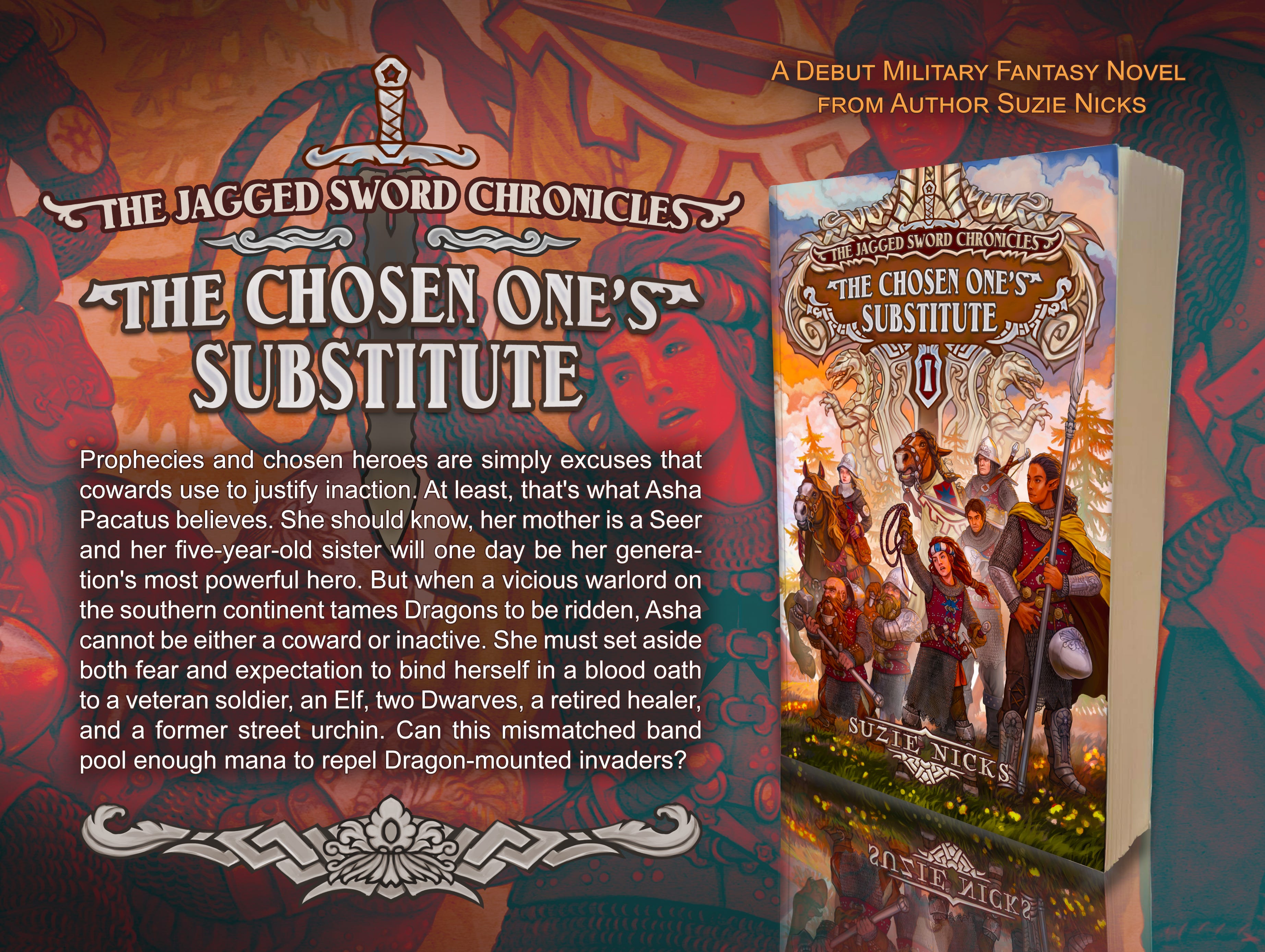
I have been working on book 2 as I prepare to launch my first book. (It is a military fantasy series. I will include a promo at the bottom because the grind never stops lol.) And I have been really struggling. I stumbled through addressing all of the things on this list. Exhaustion and quiet time were the biggest issues for me. But then I was still struggling to get anything down.
My fear that I had to conquer was that: book 1 would be very good, it would take some time to build but eventually find its audience, then book 2 would be bad and I would become of the many authors who opens with a bang but cannot write a satisfying series. (Anxiety and arrogance in equal measure I know lol.) “You have to read book 1 but after that just look up a synopsis of the rest of the series because it really falls off.” the imaginary fans tell their friends in my head.
I had to work through that before I stopped struggling, however, I was determined that I would not be one of the authors who just never finished a series. Which was what was going to happen if I didn’t keep struggling forward. This is where my routine and process saved me. I still scheduled my brainstorming and writing time, but I accepted that the words might not be good words. Or that I might only get 200 words today instead of 1k (my daily goal 5x per week). Or that the words I write today might get a massive overhaul or even completely deleted tomorrow. Ironically, on the days I told myself to just get a few hundred words, even if they are not great, have been the days I am hitting my goal, and they are (mostly) good words.
So, if you feel blocked, take a good hard look at your subconscious. What are you afraid of? Why? What is the narrative you tell yourself that needs to be debunked or perhaps just adjusted? And what is your process that will get you through until you have fixed the other things?
Thank you for reading! This is the most advice type article I have written so far here on Substack. I don’t know that I will do many more, but I guess we shall see. It will depend on how many other problems I run into that I think others can benefit from my thoughts on. Please leave a comment. I would love to hear what you do when you struggle to write or if one of these things helped you.
Good one! You hit the nail over the head :D